7 Types of DnD Name Generator for Fantasy Gaming in 2026
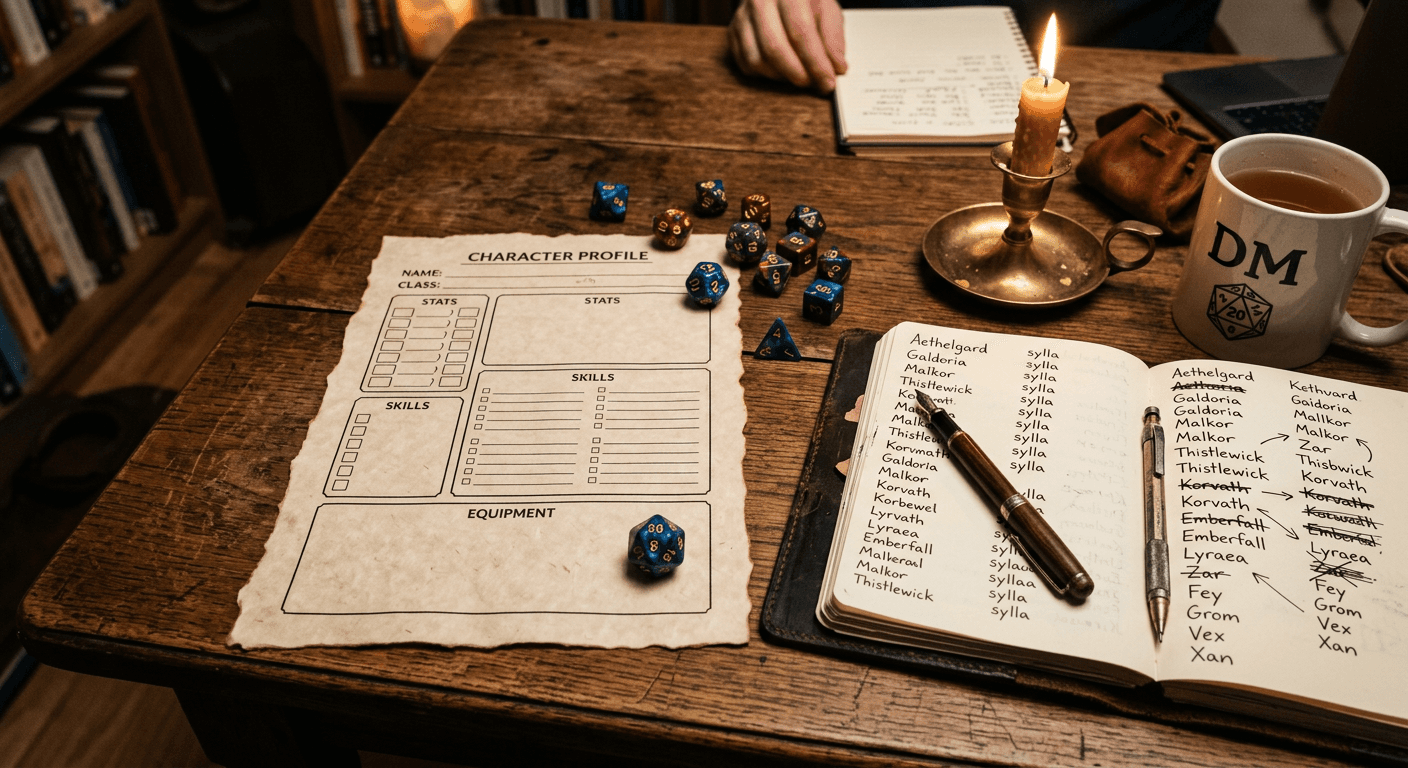
You are sitting down to a new campaign 10 minutes before session zero, staring at a blank space on your character sheet, fully aware that your table will judge your elven rogue if they end up named after a household appliance. That specific, familiar panic drives most players straight to a dnd name generator to fill the gap. Naming a character, a location, or a vehicle carries immense weight in tabletop roleplaying; it establishes tone, hints at backstory, and sets the linguistic rules for the region you are playing in.
Getting this wrong breaks immersion immediately. When a serious dark fantasy campaign suddenly features a tavern with a modern, ironic pun for a name, the tension leaves the room. To avoid this, you must understand exactly how different generation algorithms build their outputs, where their logic fails, and which mathematical approach suits the specific blank on your sheet.
Quick Summary
A fantasy name generation tool is an algorithmic utility that pieces together strings of text based on predefined linguistic rules, templates, or probability models to output setting-appropriate terminology.
- Evaluates outputs based on phonetic flow and setting coherence.
- Differentiates between Markov chain generation and static template matching.
- Highlights the failure points of literal translation tools.
- Maps specific algorithms to different tabletop roleplaying requirements.
Table of Contents
- How to Evaluate a Generator
- 1. DnD Name Generator
- 2. Drow Name Generator
- 3. Surname Generator
- 4. Nickname Generator
- 5. Band Name Generator
- 6. Ship Name Generator
- 7. Gamertag Generator
- Which Generator Fits Your Session
- FAQ
- Recommended Reads
How to Evaluate a Generator
Before selecting a tool, you must determine its underlying architecture. Broadly, these tools split into two camps: template-based arrays and Markov chain models. Template tools use hardcoded lists of prefixes, roots, and suffixes, bolting them together blindly. They ensure the output always looks like a word but often produce repetitive patterns. Markov chains analyse existing lists of names, calculate the probability of one letter following another, and generate entirely novel strings. They produce unique outputs but frequently spit out unpronounceable consonant clusters. You should choose the former for structural consistency and the latter for alien, unfamiliar terminology.
| Generator Type | Primary Mechanism | Best Used For | Common Failure Mode |
|---|---|---|---|
| General Fantasy | Array concatenation | Standard NPC naming | Cultural inconsistency |
| Linguistic | Markov chains | Non-human civilisations | Unpronounceable strings |
| Semantic | Trait mapping | Titles and reputations | Narrative dissonance |
| Alphanumeric | Database hashing | Player accounts | Lack of identity |
1. DnD Name Generator
This is the standard, broad-strokes utility built to cover the core races of traditional tabletop gaming, aimed primarily at Dungeon Masters who need to name a tavern keeper on the fly.
These platforms run on simple string concatenation. The developer compiles hardcoded JSON arrays of syllables separated by racial categories (Elven, Dwarven, Halfling). When you request an Elven output, the code randomly selects an item from the elf_prefix array, appends it to a elf_root, and finishes with an elf_suffix. There is rarely any phonetic validation to ensure the resulting vowels flow naturally into one another.
Broad utility creates generic results
Because these tools must cater to every possible setting from high magic to gritty realism, they rely entirely on established tropes. If you need a name that reflects a highly specific, homebrew culture - such as a desert-dwelling dwarven society - a standard tool will still hand you outputs full of ice and mountain references. If you are building a deeply specific world, relying on a broad tool dilutes your lore. Reading a comprehensive guide to choosing a name generator can help narrow down tools that allow custom syllable weighting.
2. Drow Name Generator
A drow name generator is a highly specialised linguistic tool designed for Underdark campaigns, catering to players rolling up dark elves who need terminology that sounds harsh, jagged, and culturally distinct.
Unlike broad templates, a dedicated tool for this race often employs a Markov chain trained exclusively on existing lexicons from established fantasy literature. The algorithm maps the frequency of specific letter transitions - noting that 'z' is frequently followed by 'r' or 'n' in this specific culture - and generates novel strings that mathematically resemble the source material, automatically inserting apostrophes to simulate glottal stops.
Phonetic accuracy creates pronunciation hurdles
The mathematical accuracy of the output does not guarantee that a human tongue can navigate it. These algorithms frequently generate strings with three consecutive hard consonants separated by an apostrophe.
Practical rule: If you cannot yell the generated string across a noisy room and be understood immediately by the listener, discard it and roll again.
Players who skip this step find themselves stuck with a character whose name is constantly abbreviated or mocked by the rest of the table. If you want to explore the specific mechanics behind this, reviewing fantasy character naming using drow and random generators provides a clearer picture of linguistic rulesets.
3. Surname Generator
A surname generator serves worldbuilders and storytellers mapping out dynastic families, noble houses, or regional histories where characters must share a clear ancestral link.
These tools bypass phonetic syllables entirely, operating on semantic compounding. They cross-reference an array of environmental or material nouns (Iron, Storm, Oak) with an array of historical professions or actions (Smith, Weaver, Rider). The script simply welds them together. More advanced versions apply a regional filter, ensuring that coastal families receive nautical prefixes while inland families receive agricultural ones.
Literal translations feel artificial over time
The honest limit here is a complete lack of linguistic drift. In reality, language degrades over centuries; 'Smithson' becomes 'Smith', and 'Oak-Town' becomes 'Acton'. These algorithms output perfectly preserved, literal English translations that feel artificial in an ancient setting. If your campaign world has a thousand years of history, populating it exclusively with pristine, literal compounds makes it read like a cartoon rather than a lived-in world. You should manually degrade the generated outputs to create a sense of history.
4. Nickname Generator
This tool is designed for rogues, arena fighters, and criminal NPCs who require an earned title or street moniker rather than a birth certificate.
A nickname generator relies on sentiment analysis and categorisation. The backend groups adjectives and verbs by tone (e.g., intimidating, stealthy, arcane). When you select a 'Rogue' class parameter, the algorithm restricts its random selection to the stealth and shadow arrays, mapping a chosen adjective to an anatomical or weapon-based noun.
Randomly assigned reputations rarely stick
Generating a reputation before the dice hit the table is a trap. If your tool hands you the title 'The Silent Blade', but your character spends the first three sessions failing stealth checks and loudly falling down stairs, the nickname immediately becomes a joke. For an earned title to carry weight, it must reflect actual gameplay. Players should use these tools for established NPCs with fixed histories, but avoid them for level-one player characters whose reputations have not yet been written. Using fun generators for games and writing is better suited for brainstorming prompt ideas rather than finalising character identities.
5. Band Name Generator
A band name generator targets bard characters forming musical troupes, or DMs who need to quickly populate a tavern's entertainment schedule for the evening.
These scripts use syntactical templates rather than vocabulary arrays. They follow strict grammatical matrices like [The] + [Adjective] + [Plural Noun] or [Noun] + [Preposition] + [Noun]. The code heavily weights abstract concepts and aggressive imagery to mimic the naming conventions of real-world musical genres.
The novelty wears off after the first tavern
These tools are almost entirely calibrated for modern irony or heavy metal parody. In a serious, gritty tabletop setting, a troupe named 'The Bleeding Goblins' or 'Symphony of Iron' instantly breaks the fourth wall. They fail spectacularly when tasked with generating something historically authentic, such as a traditional medieval chamber quartet. If you are running a sombre campaign, this tool will sabotage your atmosphere. DMs are better served by reading how to use a random name generator for creative projects to learn how to restrict the vocabulary pools to period-accurate terminology.
6. Ship Name Generator
Built for naval campaigns, pirate arcs, and spelling out transport networks, a ship name generator provides the necessary maritime terminology to flesh out coastal civilisations.
The mechanism involves cross-referencing maritime terms (Wake, Tide, Sail) with predatory animals, weather events, or abstract concepts like fate and vengeance. To ensure variety, developers program the tool to flip the syntax randomly, producing both 'The Storm's Revenge' and 'Revenge of the Storm'.
Tone mismatch derails maritime campaigns
The fatal flaw of this tool is its failure to distinguish between factions. A pirate galleon and a royal navy frigate use entirely different naming conventions, but the algorithm mixes their vocabularies blindly.
Practical rule: Never use an aggressive, blood-soaked generation for a state-sanctioned vessel, and never use a regal, abstract noun for an illegal pirate ship.
If you accept the first output the tool gives you without checking it against the vessel's in-game faction, your worldbuilding loses its internal logic.
7. Gamertag Generator
A gamertag generator is not for the character sheet; it is for the player. It is used to create digital personas for Virtual Tabletop (VTT) platforms, gaming forums, and community Discord servers.
Rather than simulating language, this mechanism prioritises database uniqueness. It takes aesthetic keywords chosen by the user and applies string manipulation: appending randomised numbers, substituting letters for numbers (leetspeak), or salting the string with symbols. Modern iterations are moving away from raw concatenation, instead integrating with LLMs to brainstorm thematic tags, though the core requirement remains string uniqueness.
Anonymity sacrifices community recognition
While these tools guarantee you a unique identifier that will pass a registration screen, they create highly disposable identities. In persistent VTT communities where finding a reliable group is difficult, an overly abstracted or heavily numbered tag makes it impossible for other players to memorise who you are across campaigns. You should skip this if you intend to build a long-term reputation as a reliable player; use a consistent, pronounceable handle instead. Exploring resources on mastering the AI prompt generator for enhanced creative workflows in 2026 can show how modern players use more sophisticated constraints to maintain their digital identity.
Which Generator Fits Your Session
Matching the tool to your immediate bottleneck saves hours of prep time. If your bottleneck is lore consistency, you must avoid broad template concatenators entirely and lean on Markov chain models trained on your specific faction's vocabulary. If your bottleneck is speed at the table, abandon the linguistic models; their unpronounceable outputs will slow your dialogue to a crawl, making standard arrays the better choice.
When mapping out dynasties or ancient history, use semantic compounding tools but manually weather the results to simulate linguistic drift. Conversely, if you need a title for an NPC who exists solely as a one-off combat encounter, trait-mapping tools provide immediate, evocative flavour without requiring background reading. The tool you choose must align with the mechanical demands of your session.
FAQ
What makes a generated character name fit a fantasy setting? A name fits a setting when it aligns with the established phonetic rules of that culture. If a region relies on harsh consonants and short syllables, introducing a flowing, vowel-heavy generation will immediately clash with the surrounding worldbuilding.
Why do Markov chain outputs sometimes look like gibberish? Markov chains calculate the mathematical probability of letters following one another based on a source text. If the source data is too small, or if the algorithm lacks rules forbidding impossible consonant clusters, it will generate strings that are mathematically valid but practically unpronounceable.
Can I trademark a name produced by an algorithmic tool? Generally, raw algorithmic outputs generated without significant human alteration are difficult to protect as intellectual property. However, once applied to a specific, unique character within a commercial setting, the combined entity may offer some protections. Always consult a legal professional regarding specific intellectual property claims.
How can I make a generated surname sound older? Simulate linguistic drift by truncating the literal output. If the tool generates 'Blacksmithson', drop the ending to create 'Blackson' or slur the vowels to create 'Blaxon'. This mimics how populations naturally shorten terminology over centuries.