How to Use a Band Name Generator and Creative Text Tools in 2026
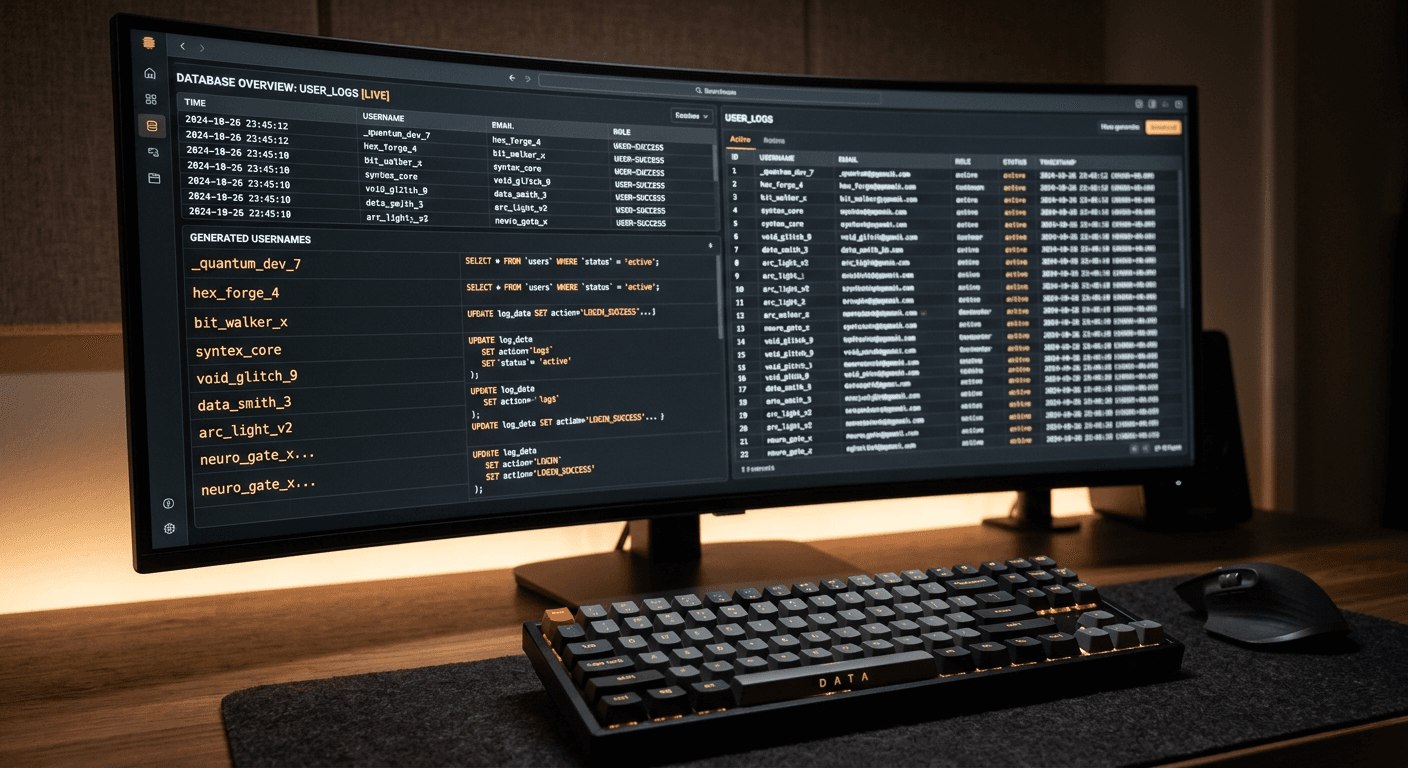
You are staring at a digital registry screen. The audio interface is plugged in, the stream overlay is rendered, and your cross-platform profiles are waiting to be claimed. But every handle you type into the database returns the exact same red error text: "Username already taken." It is the moment digital creators and community builders realise that securing a unique identifier requires more than just brainstorming with a notepad. To get past the wall of registered accounts and parked domains, you must systematically use a band name generator and programmatic text tools to assemble strings that no one has claimed yet. This guide details the data mechanics of these tools, how to format your inputs, and where algorithmic suggestions fail.
Quick Summary
Creative string generators are combinatorial algorithms that splice dictionary arrays, parse phonetic overlaps, or process structured seed words to output unique identifiers. Understanding how these tools process data prevents you from adopting generic or unusable digital handles.
- Generators rely on either static dictionary arrays or Markov chain probability models.
- Bypassing platform character limits requires structural planning, not just vowel deletion.
- Portmanteau generation relies on phonetic collisions between root words.
- Always manually verify an algorithmic output against local trademark databases.
Table of Contents
- 1. Map the Semantic Boundaries Before Generating
- 2. Layer Syntax and Pacing into a Band Name Generator
- 3. Construct Gamertags Around Ecosystem Restrictions
- 4. Map Relationship Dynamics with a Ship Name Generator
- 5. Flesh Out Roster Context Using a Character Generator
- Common Pitfalls & Troubleshooting
- FAQ
- Recommended Reads
1. Map the Semantic Boundaries Before Generating
Before you open an interface and click a button, you must understand what the software is actually doing. Most users assume these platforms conjure words out of thin air. In reality, a random username generator is a script querying fixed arrays of text. It pulls a string from a "noun" array, a string from an "adjective" array, and perhaps a randomised integer, concatenating them into a single output.
Why Dictionary Constraints Dictate Output Quality
If you do not intervene in this process, you will receive the exact same noun-adjective combinations as thousands of other users. The underlying mechanism is purely mathematical. If a tool has 500 adjectives and 500 nouns, it only possesses 250,000 possible combinations. In a global digital market, a quarter of a million variations will be exhausted by newly registered accounts within weeks. To extract value, you must supply your own arrays.
When exploring how to use a random name generator for creative projects, the crucial step is bypassing the default dictionary. Inject highly specific seed words relevant to your niche. If you are building an electronics repair channel, do not use generic tech terms like "wire" or "spark"; seed the engine with terms like "flux", "cathode", or "solder". By forcing the algorithm to cross-reference your hyper-specific vocabulary with its broader linguistic database, you generate strings that sound native to your industry but remain mathematically distinct enough to pass a registry check.
Check your tool's settings for custom input fields today. If the platform only offers a single "Generate" button with no text-entry boxes for custom prefixes or suffixes, you are using a closed-loop system that will only deliver exhausted options.
2. Layer Syntax and Pacing into a Band Name Generator
Musical groups and performance duos operate under entirely different linguistic rules than individual digital accounts. A band name generator does not merely stack words; the sophisticated versions use Markov chains. These probability models analyse a dataset of existing bands within a specific genre and calculate the likelihood of one syllable or character following another. This is why a generated metal band sounds entirely different to a generated indie-pop duo, even if the root words share similar meanings.
Controlling Syllabic Rhythm and Phonetic Weight
The failure mode here is entirely rhythmic. Users frequently accept an output that looks visually striking on screen but falls apart when spoken aloud by a venue promoter or a radio host. A strong identifier relies on trochaic meter - a stressed syllable followed by an unstressed one - or a deliberate, punchy cadence.
When using creative ways to use a random word generator, you must act as the phonetic filter. Generate a list of twenty outputs, then read them aloud into a microphone. Pay attention to plosive consonants (P, T, K, B, D, G). A title heavy with plosives cuts through background noise and is inherently easier for an audience to remember. Conversely, too many consecutive sibilant sounds (S, Sh, Z) create a hissing effect that is notoriously difficult for audio compressors and vocalists to handle clearly. If your generated string requires careful enunciation to prevent it blurring into a single unreadable sound, discard it immediately, no matter how clever the pun appears in text.
3. Construct Gamertags Around Ecosystem Restrictions
Gaming platforms enforce some of the most rigid database restrictions on the internet. A gamertag generator must navigate string-length limits, forbidden character lists, and aggressive automated profanity filters. Furthermore, these identifiers must scale from a tiny scoreboard font on a television screen to a massive banner on a link-in-bio profile.
Platform Limits and Screen Readability
Most modern gaming infrastructure caps display names at 15 or 16 characters. If an algorithmic tool outputs a 20-character string, it is functionally useless. Beyond length, you must account for typographic ambiguity. In many sans-serif fonts used by streaming overlays and user interfaces, a capital "I" (India) and a lowercase "l" (Lima) are visually identical. If your generated handle relies on these characters, impersonators will immediately register the visual clones, splintering your audience.
Practical rule: Never substitute a letter for a number just to bypass an unavailable username; it destroys your verbal branding when a caster or collaborator tries to say the name aloud during a live broadcast.
Instead of falling back on numbers or underscores when your ideal string is taken, append a silent industry modifier. Adding "HQ", "Live", or a regional prefix changes the database string entirely without altering how the community refers to you in spoken conversation. Test the generated string by typing it into a standard digital business card layout or a social media bio simulator to verify its visual footprint.
4. Map Relationship Dynamics with a Ship Name Generator
Community managers, fan-fiction writers, and collaborative streaming channels frequently need to merge two distinct identities into a single recognisable brand. A ship name generator handles this specific mechanical task: the programmatic creation of portmanteaus.
The Mechanics of Portmanteau Blending
This is not simple concatenation. A competent portmanteau algorithm calculates the phonetic overlap between two input strings. It identifies the onset (the initial consonant sound) of the first word and splices it with the rime (the vowel and final consonants) of the second word. The software scans for shared vowels to serve as the structural joint, ensuring the transition between the two words feels linguistically natural rather than forced.
Users often break this process by forcing the algorithm to combine words that share no phonetic similarities. The result is a jarring consonant cluster that is impossible to spell. When studying fantasy character naming using drow and random generators, the core lesson is that the root of both original words must remain legible. If the splice removes the defining syllables of either identity, the community will not adopt it. Check the output by ensuring at least three consecutive letters from both original handles have survived the merge intact.
5. Flesh Out Roster Context Using a Character Generator
For role-playing communities, narrative podcasters, and game developers, isolated names are insufficient. You need context. A character generator goes beyond string concatenation by outputting structured data arrays - pairing a generated identifier with a simulated background, a set of attributes, and regional origins.
Moving From Bare Strings to Narrative Anchors
The mechanics here usually involve querying a relational database. When the engine selects a geographical origin, it filters the surname array to match the linguistic conventions of that simulated region. The critical mistake practitioners make is treating this output as a final product rather than a foundational prompt.
To maximise utility, especially when mastering the AI prompt generator for enhanced creative workflows in 2026, you must export the generated data and feed it into a broader context window. Take the raw JSON or text output from the generator - complete with the character's traits, flaws, and generated title - and use it as the structural constraint for your own writing. This guarantees your digital roster maintains internal consistency. Today, verify whether your chosen platform allows you to export generated lists in a CSV format rather than forcing you to copy and paste single entries manually.
Common Pitfalls & Troubleshooting
Navigating programmatic text tools frequently results in structural errors. Below are the most common failures, the symptoms you will see, and the specific corrections required.
The Algorithmic Echo
Symptom: You generate a title, search for it online, and discover three other creators in your exact niche registered the identical phrase this month. Fix: This is the most frequent real-world failure. You are relying entirely on the default dictionary arrays provided by a web tool. The fix is to stop using tools that do not accept custom parameters. Input your own highly specific vocabulary lists and force the engine to combine your unique strings rather than its native defaults.
Unreadable Typographical Collisions
Symptom: Your audience routinely misspells your handle when attempting to tag you, resulting in lost engagement analytics and broken links. Fix: The algorithm has generated a string containing repeating consecutive consonants or ambiguous lettering. Remove double letters entirely. Strip out all underscores and hyphens. A handle must survive being typed quickly on a mobile keyboard; if it requires shifting to the symbol menu, it is failing as a digital identifier.
Cross-Cultural Slang Violations
Symptom: An apparently clean, punchy string provokes unexpected filtering, shadow-bans, or negative reactions from an international audience segment. Fix: Algorithms splice syllables without regard for global semantics. A generated portmanteau might accidentally spell a highly offensive slur in another language. Run the exact output string through a comprehensive, multi-region translation engine before you register the domain or mint the digital business card.
The "Handle Taken" Dead End
Symptom: The exact generated string is heavily parked by domain squatters or dormant accounts across every major social environment. Fix: Do not append numbers. Instead, append an action verb or a medium-specific noun. Moving from "NeonPulse" to "PlayNeonPulse" or "NeonPulseAudio" bypasses the database collision while preserving the core brand identity entirely.
FAQ
Does using a generator grant me copyright over the resulting name?
No. Merely generating a text string through a web interface establishes no intellectual property rights. Trademark and copyright protections generally require applying that specific string in active commerce or trade. Always cross-reference your generated outcome with regional intellectual property databases.
Why do AI prompt tools produce the same naming styles for everyone?
Large language models operate on probabilistic text generation and often default to a specific, homogenised tone based on their underlying training data. Unless you aggressively adjust the temperature settings and mandate structural constraints in your prompt, the AI will gravitate toward the most mathematically average output.
Should I match my digital handle exactly to my registered domain name?
Yes. Maintaining a 1-to-1 match between your cross-platform identity, your link-in-bio URL, and your primary domain prevents audience leakage. If the exact match domain is taken, it is often safer to generate an entirely new string than to operate under a fragmented digital identity.
How do I force an algorithm to use a specific linguistic root?
If the tool lacks explicit language toggles, you must override its behaviour by supplying a robust seed list formatted exclusively in your target language. By flooding the input fields with your chosen dialect, you restrict the engine's ability to pull from its default English arrays.
Recommended Reads
- To evaluate different platform architectures, review a comprehensive guide to choosing a name generator.
- For alternative methods of structuring text, examine creative content tools for word clouds, poetry, and lyrics.
- If you need to format your final output for complex user interfaces, learn about creative text styling using fancy and small text generators.